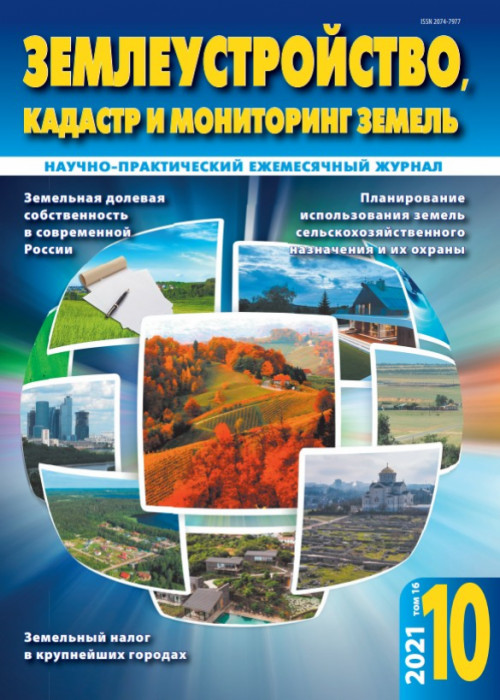
The article provides a brief analysis of the content and results of the implementation of models for organizing agricultural production during the land reform in Russia in the 80-90s. The article contains the main stages of land reform, confirmed by legislative and regulatory legal acts of the state. It has been established that shared land ownership in agriculture has a number of specific economic functions: quasi-property, goods, capital and property. The studies demonstrated that the allocation of land shares and their transformation into land plots is a condition for the implementation of the production function of quasi-ownership of land shares. For this reason, land shares, including unclaimed ones, not allocated to land plots, should not be classified as full-fledged private land ownership. When equity ownership is included into the authorized capital of an economic entity, and the agreement on the transfer of rights with the legal successor is not assigned, the right holder loses all rights to the transferred land shares. The existence of such an agreement does not guarantee that the right holder will receive any payments for the use of such property by the legal successor. Individuals who invested land shares in the authorized capital of an economic entity did not have any economic benefit from the reform, and those who converted land shares into a land plot received land property, the price of which has risen in dozen times since the beginning of the land reform.
The article describes consequences of transformation of municipal regions into urban districts and provides characteristics of municipalities and dynamics of areas of agricultural lands and indices of their use in Moscow region. Based on the urban district of Solnechnogorsk, the main issues of land use planning scheme developed for a municipality are discussed in this paper.
This article examines the issues of the principle of dispositiveness in administrative proceedings. The active role of the court in the proceedings on cases arising from administrative legal relations is revealed in this paper.
This article covers the issues raised by the objectives of the "The Program for complex development of rural territories" and its subprogram "Providing rural population with affordable and comfortable housing". The authors substantiate the concept "rural agglomeration" and make the suggestions on how to choose rural settlements and land plots suitable for large-scale development of low-density residential areas.
The article contains a comparative analysis of land taxation in the largest cities of the Russian Far East and includes: assessment of land resources by categories and types of ownership, differentiation of land tax rates by types of permitted use and cadastral value by segments of local land markets. A specific feature of the Far East cities is a high share of forests, determining a relatively low share of private property in the structure of urban lands. The real fiscal autonomy of a local self-government bodies in Russian Federation in the field of land and property policy was proved in this work.
The article provides a methodological approach to land value calculation and determination of the capitalization ratios. Based on the analysis of methods for land assessment, it is proposed to calculate the capitalization ratio by solving a system consisting of seven equations characterizing the state of the real estate market. The areas of possible use of the approach and the need to develop a resource model for the decomposition of real estate objects are substantiated in this paper.
The article is about the issue of state legal regulation in the field of protection and implementation of cadastral registration of cultural heritage objects. The importance and relevance of the protection of cultural heritage objects is confirmed by the negative urban planning practice, which in some places completely excluded historical settlements from the territory of the country. The authors proposed some clarifications to reduce the fragmentation of legislation.
The authors considered the sequence of actions for the implementation of state cadastral registration of land plots using geographic information systems, mentioned the improved mechanism for the use of GIS technologies for state cadastral registration, and assessed the effectiveness of such technologies. The authors noted that it is advisable to develop and adopt normative legal acts that regulate relations in the field of application of GIS systems in cadastral activities nowadays, and to bring all GIS to a solid maintenance and systematization, as well as to strengthen the involvement of users in the legal culture of open databases on the Internet using cartographic materials. By the authors, the developed proposals can be recommended for use by cadastral engineers to perform the procedures for state cadastral registration of land plots.
The article deals with the problems of surface waters in the Khanty-Mansi Autonomous Okrug-Yugra, which contain a large amount of oil products and phenols. Oil is the most dangerous pollutant for water resources. The land "flavored" with oil dies for several decades, oil oppresses soil biota, pollutes surface and ground waters. We need innovative purification methods and technologies to purify and improve the conditions of water.
The problem of nature protection and, at the same time, the formation of an environmentally friendly architectural space is becoming more and more important at the present time. The natural and climatic factor is a particularly significant element of the compositional and volumetric-spatial solution of individual buildings in the natural environment. The article examines the role of the local terrain in the design of an individual eco-friendly residential building.
The author considers the use of the databases created in MS Excel spreadsheets as a thematic educational technology. It has significant advantages over presentations, which are firmly embedded in the educational process. The application of the thematic educational technology "Database" in the educational process is shown by the author on the example of one block of the subject "Modern problems of land management and cadaster": Modern technologies for providing information about land resources "WEB technologies for mapping the Earth" and "Remote sensing data".
The article is devoted to the issue of state legal regulation in the field of protection and implementation of cadastral registration of cultural heritage objects. The importance and relevance of the protection of objects of cultural heritage are confirmed by the negative urban planning practice, which in some places completely excluded historical settlements from the territory of the country. Some clarifications are proposed to reduce the fragmentation of legislation.