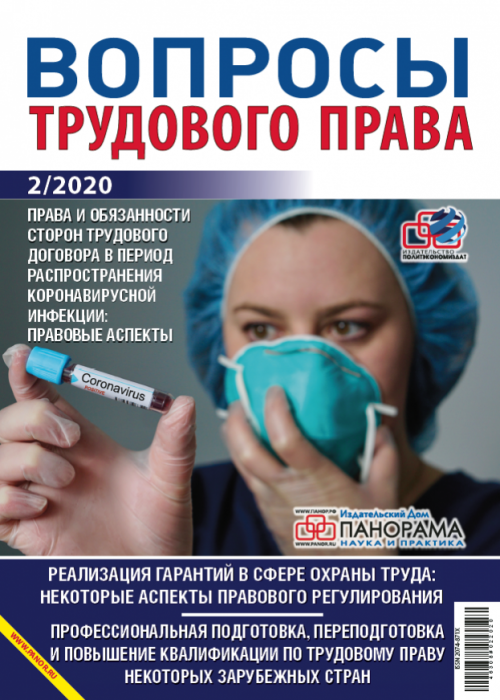
The article analyzes the basic rights and obligations of an employee and employer during an outbreak of coronavirus infection. Questions about passing an extraordinary medical examination, suspension from work, refusal of an employee from a business trip in order to prevent infectious diseases and (or) in case of the threat of epidemics are investigated. Some problems are identified and ways to solve them are suggested.
The article discusses the new developments in the legal regulation of work in remote mode — that limits the use of this form of labor relations, taxation of remote access to their social security, the distinction between these workers and selfemployed people, as well as difference remote of the place of work and a separate subdivision of the enterprise or organization. Measures are proposed to streamline the involvement of remote workers and to prevent tax and financial conflicts in this area.
This article deals with such a topical issue of labour law as the legislation on travelling and mobile work. At present, there are quite a few questions in practice concerning the nature of the application of legislation to these types of work. The analysis of the concepts of travelling and mobile work revealed similarities and differences between these types of work and defined them.
The article discusses the legal consequences of dismissal from the civil service due to loss of trust and the possibility of restricting access to the public service of persons dismissed due to loss of trust.
The article is devoted to the identification of peculiarities of training, retraining and advanced training of customs officials. The features of implementation and the role of training of customs officials are identified. The role of the institution of mentoring in the customs sphere has been identified. The peculiarities of the legal and regulatory framework regulating the procedure of professional training in customs business, peculiarities of internships in professional activity, role and peculiarities of profiogram in customs business are reflected.
The article, based on an analysis of the labour codes of some foreign countries, considers topical issues of vocational training, professional retraining and advanced training of employees (personnel) with a view to possible use of their positive experience in Russian labour legislation.
As the main task the Labor code of the Russian Federation establishes the priority of preservation of life and health of workers. However, according to the authors, the latest changes in the Russian legislation on labor protection, indicate a decrease in the level of state support in this area, which does not contribute to ensuring safe working conditions.
The article analyzes the changes and additions made to the Labor Code of the Republic of Belarus in the field of legal regulation of working time (which entered into force on January 28, 2020). The current norms of the Labor Code of the Republic of Belarus are assessed, and directions for further improvement of labor legislation are highlighted.
The article considers issues related to the legal regulation of labour migration, pays attention to the concept of labour disputes in Russia and abroad, the development of legislation on labour disputes, the concept of labour disputes in the countries of the Eurasian Economic Union, the practice of considering labour disputes.
Is it possible to apply a student contract for professions such as cleaner, loader, utility worker? This and other questions are answered by the specialists of the Legal Consulting Service GARANT