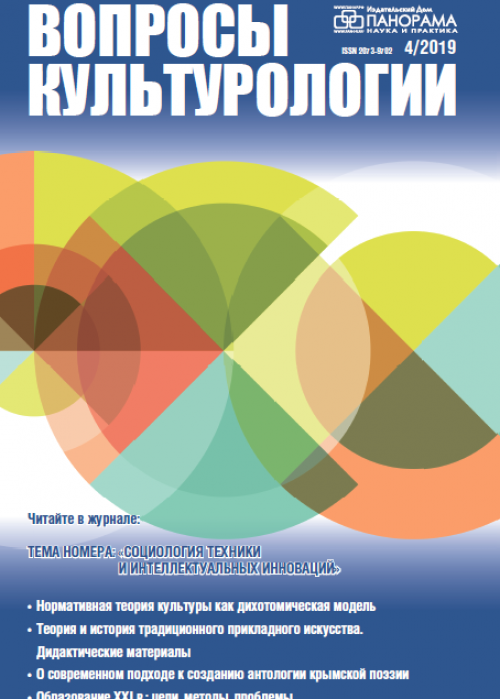
The purpose of this paper is to acquaint readers with the research conducted by students and employees of the State Technical University. N.E. Bauman, who reveals the current interaction of the average citizen of Russia with technology. What do people understand by technology, how do they use them at home and at work? How do they use mobile phones, which mobile applications attract them? Are there any specific features that distinguish Russians from others? As residents of Russia assess their level of mastering technology, this is what this paper says.
The modern world economy is based on the development of technologies, which, in turn, are involved in all spheres of our life, including the public. The focus of this paper focuses on the attitude of Russians to modern technologies and their use. The paper touches upon the problems of awareness of the current state of the technological sphere, computer equipment of everyday life; highlights the gender aspects of the use of technological innovations and inventions. The study is based on data obtained from a questionnaire and an interview.
The paper is an exposition of the author's interpretation of culture as a dichotomous structure that underlies the Normative Theory of Culture, considered as a set of standards for human consciousness and social behavior. At the same time, there are paired functions of social integration and social localization, collective and individual culture, cultural stability and variability, innovations and traditions in culture, etc.
Reference book is addressed to students studying the theory and history of traditional applied art. It is a set of materials for self-extracurricular work. There are of the questions and tasks for research, artistic and creative activities, information and reference materials, dictionaries and references. The presented theoretical and practical material reveals the main aspects of the existence of traditional applied art in Russia, the logic of development, successive artistic and stylistic features of the language of its specific types.
The author addresses the topic of informational aggression, its forms and tools. Particular attention is paid to the phenomenon of «brain» (mental) virus as a means of influencing the audience. It was concluded that all social upheavals in Russia over the past 30–35 years are the result of an acute confrontation between patriotic and globalist worldviews, concepts, rhetoric and views.
The author, a well-known Russian politician and legal scholar, talks about his experience of communicating with Oleg Yemelyanovich Kutafin (1937–2008) — Academician of the Russian Academy of Sciences, one of the authors of the current constitution of Russia.
An article by the chairman of the Constitutional Court of Russia V. Zorkin in the Rossiyskaya Gazeta excited the public. The idea of constitutional reform, carefully ignored by the official media, was again relevant. What are the prospects for the constitutional process? This is what our author writes.
A thorough study of the history of the main Orthodox Church — Constantinople. The author uses a large amount of information about the relationship of the Patriarchate of Constantinople with Christian communities, secular authorities, as well as with other bishops, including the Roman one. It was concluded that the special role played by the patriarchate in the process of secularization of the church life and the control of anti-Christian forces over it.
In paper, in the light of understanding of basic advantages of Russian poetry’s anthology as metatext genre, experience and complexity of the Crimean poetry anthologies’ creation is considered in the conditions of unprecedented expansion of literary material’s volume; the attention aims to a geopoetic foreshortening of the Crimean text concept as a productive basis of modern approach in finding of the Crimean poetry’s meanings and its antologization.
The Russian State Archive of Socio-Political History holds a conference on the theme «Left ideologies, movements and organizations in history. Historical documents and topical issues of archeography, archival science, source study, domestic and general history of the New and very New Times» (Russia, Moscow, April 3–4 2019).
University at the Inter-Parliamentary Assembly of the EurAsEC (Russia), Department of Social and Humanitarian Disciplines of the National State University of Physical Culture, Sports and Health P.F. Lesgaft (Russia), Bukhara State Medical Institute Abu Ali Ibn Sina (Uzbekistan), Department of Philosophy and Social Sciences of the Armenian State Pedagogical University H. Abovyan (Republic of Armenia) is holding оn May 23–25, 2019, an international scientific conference «Education of the 21st century: goals, methods, problems».