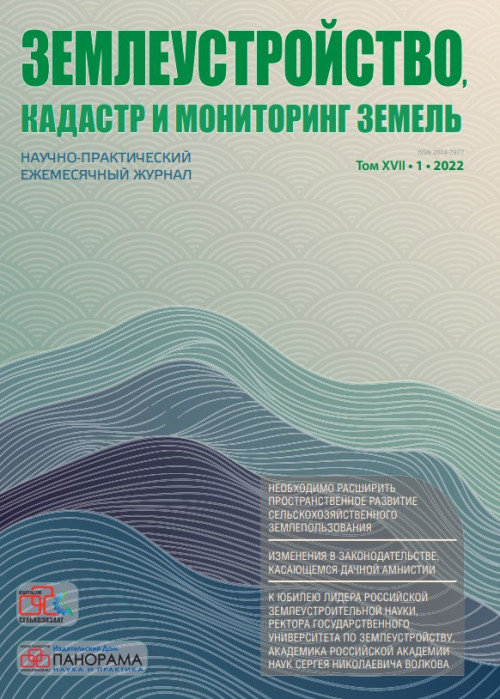
The existing resource potential of productive agricultural land is not used by one third, and the productivity of used agricultural land barely reaches 20-40% of the potential yield. Agriculture in many regions has ceased to be an essential part of rural economy, a source of jobs and income for rural residents. There is a steady tendency to shrink living space – bankruptcy of agricultural producers, depopulation of rural areas, crushing and disappearance of villages, degradation of engineering and social infrastructure. Life in many rural areas is supported by the pensions of the elderly and the salaries of state and municipal employees. Many rural areas of the Non-Black Earth Region, remote from large civilizational centers, are turning into territories of survival without any hope of revival. Instead of contemplative observation, it is necessary to make reasonable management decisions and mechanisms for their implementation, including support for those who need it instead of feeding people hiding in offshores the super profits received in Russia.
The effective functioning of high-performance agricultural machinery requires taking into account its technical characteristics when organizing the territory of agricultural organizations. The article discusses the issues arising during land management in agricultural organizations, identifies the features of the use of agricultural machinery, presents the technical characteristics of foreign and domestic harvesters in various natural zones of the Russian Federation, and formulates recommendations that must be taken into account when designing crop rotations and arranging their territory in projects of on-farm land management.
The article provides a brief history of the interaction of SULUP and religious organizations. The main works carried out by the SPO «Surveyor» SULUP on the church lands are presented in this paper. The work prospects of the student squad are considered here as well.
A correlation matrix of six factors by the shares of land and vegetation from the total land area in 14 subjects of Western Siberia is considered in this paper. The group correspondence is assessed above 0.98 for the ecological coefficient X17, and above 0.99 for the other five parameters. The first place is taken by the parameter X14 – arable land. The coefficient of correlative variation is 0.8769 ("the more → the worse"). The factors X12 – farmland, X14 – arable land and X16 – human-modified lands are oriented to the factor «the less, the better», and X13 – forests, X15 – vegetation cover "grass + bushes + trees", and X17 – the ecological coefficient "the more the better". The greatest correlation coefficient of 0.9996 was obtained by the influence of X17 on X16. The interesting one is also X14 (arable land) – X12 (farmland).
The article examines the activities of the Grand Duke, commander, diplomat, thinker of the Ancient Russia during the period of the highest danger – the late 30s – early 50s of the XIII century.
The article is about the development of the structure and content of the land monitoring database (DB) on the example of Chelyabinsk region. First of all, the author performed an analysis of various database models and software environments, investigated advantages and disadvantages, and chosen the optimal DB model. After that, the author identified the territorial features of the region, which are taken into account in development the structure and content of the database.
This article analyzes the changes in legislative acts concerning a simplified procedure for registration of ownership of individual residential houses, garden houses, residential buildings, as well as outbuildings erected on land plots provided to citizens for gardening, for individual housing construction or for personal subsidiary plots.
The article describes the basic concepts of zones with special conditions of use, security zones of real estate objects, and their types, features of establishment and principles of regulation.