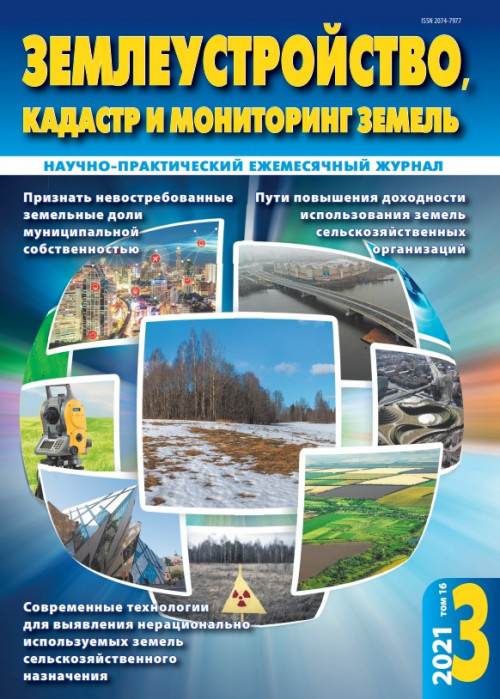
The purpose of the article is to investigate the mechanism of transfer of unclaimed land shares to municipalities that has been used since 2011, and consider what results have been achieved and what difficulties have been taken place during implementation. The author realized that the transfer of unclaimed land shares to municipal property resolving the problem of shared ownership in general.
The article examines land qualities that form natural and production potential making evaluation of this potential, the cost of arable land and the associated profitability possible.
In this article, the authors consider and analyze modern technologies for identifying irrational agricultural land, as well as the goal, objectives and requirements of land management in farms with significant amount of unused land.
The article examines publication activity, and provides a general overview of key scientific and technological features and also analyses domestic and foreign research in the field of land management. The conclusions highlight the focus of the Russian scientific community and propose the ideas for development prospects of this field.
The article is about the formation of a new system of state cadastral evaluation of real estate after the coming into force the Federal Law "State Cadastral Evaluation". An analysis of the results of the first round (2018-2019) of the state cadastral evaluation carried out according to the new rules is presented in the paper by example of agricultural lands in the Central Federal District of Russia. The author proposed the scheme of the new cadastral evaluation system.
The article deals with the most important problem of modern cities - the combination of the "new architecture" with the historically established quarters. This problem is caused by the emergence of innovative trends in architecture, which are formed under the influence of aesthetic, cultural, financial trends, as well as technological progress.
The article analyzes the negative impact on agricultural lands, especially irrigated arable lands and perennial plantations, and gives recommendations for prevention of negative results. Realization of these recommendations can significantly increase the efficiency of land use.
The article discusses the features of land management for agricultural organizations in conditions of radioactive contamination, and also suggests the most effective ways to reduce the negative impact of radioactive contamination on agricultural production.
The article presents data on the University of Land Use Planning's activities in 2020. The University performance indicators are presented according to the monitoring conducted by the Ministry of Science and Higher Education of the Russian Federation. The data concerning the number of directions and specialties of students» training, quantity of educational programs, number of applicants and students, general number of graduates, additional professional education, scientific and international activity, property complex management, as well as the activity of the Educational and Methodological Council on Education in the sphere of land use planning and cadasters (EMC) are considered in this paper. The achievements are shown in educative, cultural-mass, training, sports and recreation work.
The article considers the most important problem of modern metropolises – the combination of "modern architecture" with the historically established urban landscape. This problem is caused by the emergence of innovative trends in architecture, which are formed under the influence of aesthetic, cultural, financial problems, as well as technological progress.