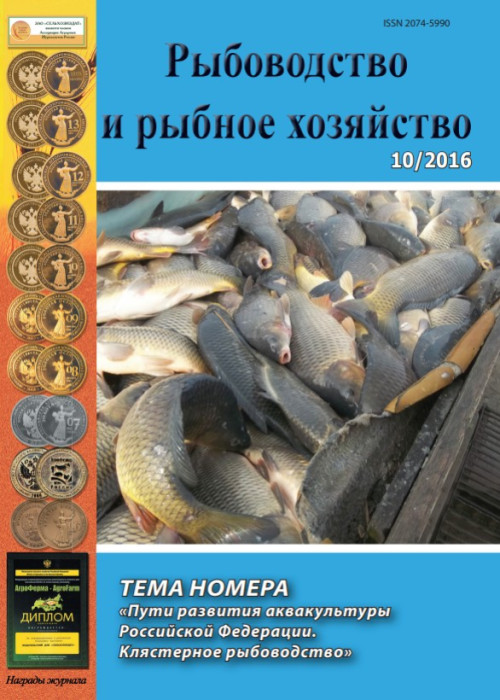
The paper examines the natural resource and production potential of prospective development of aquaculture in the Russian Federation. The factors constraining the growth of productivity of agricultural farming are specified. The changes in the intensity and structure of production of fi sh products during the end of the XXth century and the beginning of the XXIst century are analyzed. The reason of active growth of the intensity of fi sh production in aquaculture in Russia until 1990 is determined; it is a change in legal organizational forms of production. The causes of the crisis of the production technology of carp fi sh unlike the technology of production of trout are identified. The necessity of the fi sh clusters as new organizational and legal forms of management, which allows to increase the intensity of fi sh production in aquaculture in the country is explained. In order to improve production efficiency, it is proposed to develop the structure of fi sh clusters with integrated production of various agricultural products and the provision of commercial services.
The principles and operation of the ponds of the Lower don in the I cycle of cultivation of sturgeon juveniles, is the impact on the biotic and abiotic components of the environment. Review individual solutions to the problem of reducing the period of cultivation in ponds due to the rational use of schemes of measures to optimize the environment. The implementation and consistency of compliance in the ponds of the complex of measures to optimize all levels of the trophic chain in full will allow to reduce terms of cultivation of juvenile fi sh, enhancing its vitality, and to exhaust the young of higher mass than the conventional standard.
For maintenance of animal breed genetic pool including carp as the most widespread object of pond fi sh breeding, it is stipulated forming of collection replacement — brood stocks on the base of selection and breeding farm “Isobelino”, Agricultural Production Institution. The imported carp breeds constitute quite a valuable genetic pool adapted to the conditions of fi sh farms of the Republic for the life of three-four generations that is used for further selection and breeding works and also for obtaining commercial crosses.
There are investigated general status and recent trends in development of aquaculture in the Republic of Belarus. It is shown that pond fish farming with Carp as main basic species still predominates. Breeding of other species, although intensively progresses, in total volume makes around 20 % only. Industrial trend of aquaculture is developing in proportion to construction o industrial facilities, some problems with fodder and seed providing exist. There are addressed some potentialities of innovation development based on scientific research results.
Helminthofauna in carp fishes from water bodies of the Central Zone of the Russian Federation numbers (by our data) 25 species of helminths. The most part of helminths is represented by trematodes. Helminths from the genera Diplostomum and Ichtyocotylurus — Ligula, Digramma — are of the epizootic importance. An epidemiologically important helminth, Pseudoamphistomum truncatum, has been revealed, which metacercaria were found in muscles of bream, roach, ide and Aspius aspius.
The paper discusses some aspects of the assessment of fishery resources in the ecosystem services complex. Determining of the value of the natural resources is necessary for their inclusion in the national planning and management of natural resources, the development of plans for socio-economic development of territories, evaluating of damages and for other economic indicators.
The studies demonstrated that feeding of multiple age groups of channel catfish with balanced combined feeds with the addition of feed supplements NUPRO® and BIO-MOS® increased their growth intensity, an increase in fi sh growth rate and fi sh output and to a reduction in feed costs for fi sh rearing. The results of the conducted works allow determining the optimum doses of the addition of feed supplements NUPRO® and BIO-MOS® in the composition of combined feeds for feeding multiple age groups of channel catfish reared in the controlled conditions of aquaculture, which are as follow: NUPRO® when added to the feed of channel catfish larvae — 0,5 %, young of the year — 3,0 %, age 1 + channel catfish — 5,0 %; BIO-MOS® for channel catfish larvae — 0,5 %, young of the year and age 1 + channel catfish — 5,0 %.
The distribution and biological features of threatened species Acipenser oxyrinchus Mitchill, 1815 are reviewed. The third part of review is devoted to the southern subspecies Gulf sturgeon Acipenser oxyrinchus desotoi Vladykov, 1955. At present Gulf sturgeon has only 7 populations. Largest populations inhabit Suwannee River and Choctawatchee River. Gulf sturgeon has unique features –spring migrations from Mexican Gulf to rivers where sturgeons spent summer, don’t eat and only lose energy resources. Individual fi sh can lose up to 30 % of their body weight during the summer fasting period. But, this weight loss is more than compensated for during the next round of winter feeding, when Gulf sturgeons can increase their body weight as much as 130 %. Gulf sturgeons have jumping activity with peaks at dawn and dusk.