This article examines the features of foreign trade relations between the European Union and Vietnam at the present stage, describes the terms of the free trade agreement between partners, which entered into force last year. The novelty of the article lies in the fact that the study provides up-to-date detailed data on foreign trade between Vietnam and the EU for 2020. When writing the article, the statistical and mathematical method of scientific research was actively used.
The article analyzes the strengths of innovation policy and the development of an innovation cluster in Finland. The main directions of development of sectoral ecosystems are indicated.
This article examines the features of Vietnam’s foreign trade at the present stage. The article, based on rich statistical and factual material, shows how a balanced policy of openness based on free trade and the creation of favorable conditions for foreign investment leads to rapid economic growth. The novelty of the article lies in the fact that it contains the latest statistical data for 2020 regarding the government of the Socialist Republic of Vietnam overcoming the coronavirus crisis. When writing the article, the statistical and economic method of scientific research was actively used.
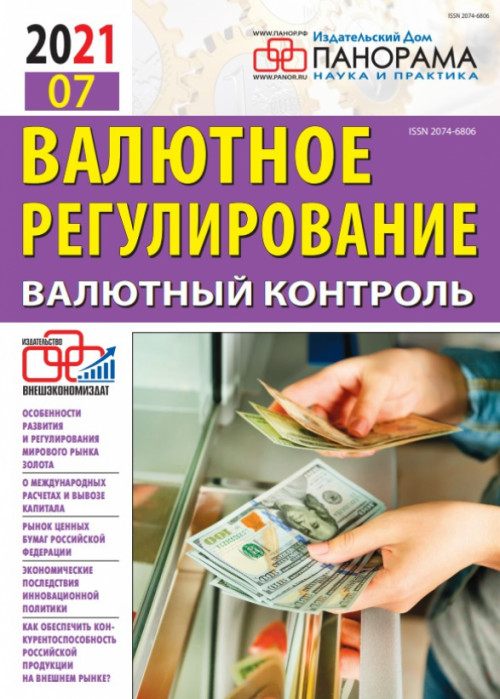
This article presents an analysis of the formation of the global gold market and the features of its regulation. The analysis of various classifications of the gold market made it possible to distinguish the following: to date, the global gold market has formed as an extensive structure of trade in physical metal, which operates on a commercial basis and is almost completely exempt from state regulation. Based on a study of exporting countries and gold importing countries, features of regulation of the global gold market were identified.
This article discusses two important problems: the system of making international payments and the export of capital from Russia. In 2020, the net capital outflow from Russia doubled and amounted to USD 47.8 billion. For comparison: in 2019, capital outflows amounted to USD 22.1 billion. The article analyzes the current situation and formulates proposals for measures of state regulation to reduce capital outflow.
The current stage of the functioning of the domestic securities market is influenced by various factors that can hinder its development. In 2020, the world is facing a new threat — the COVID-19 coronavirus pandemic. The article is designed to determine the impact of the pandemic on the level of activity of professional and non-professional participants, as well as to study the main trends and possible development prospects. The authors of the study reflect the dynamics of transactions with securities, as well as analyze the indicators of the Moscow Stock Exchange. An unprecedented surge in the investment activity of individuals and an increase in the placement of securities by companies that managed to significantly increase their profits due to the consequences of the pandemic are reflected. Based on this, the main reasons for the increase and decrease in indicators on the securities market of the Russian Federation are identified, and measures are proposed to stimulate positive processes.
The article analyzes the Finnish business environment based on the Doing Business rating, and highlights the strengths of doing business. The main changes that have occurred over the past 10 years in the development of entrepreneurship are listed. Comparative characteristics of the institutional environment and measures of state support for SMEs in Finland and the Russian Federation have been carried out.
The research presented in this article is presented in the form of an analysis of the financial aspects of the development of innovative activity in the agro-industrial complex of the Krasnodar Region. Based on the results of the study, the problems of innovative and technological development of the agro-industrial complex of the Krasnodar Region are identified, the ways of their solution are substantiated and, based on the theoretical and methodological base of domestic and foreign literature, special economic conditions are proposed, upon reaching which, the most rational way of developing the financial and innovative potential of the agricultural sector is possible. sectors of the Krasnodar Region.
The article describes the features of the Finnish economy and its foreign trade. Finland is a promising partner for Russian companies. The potential for cooperation has not been exhausted, and new prospects are opening up over time. The bilateral foreign economic cooperation between Russia and Finland has a historical foundation and a modern superstructure that must be taken into account.
The article raises the question of the necessary restructuring of Russian industrial enterprises, the implementation of digitalization of production. The author proves the need for this restructuring as an important factor to ensure the competitiveness of domestic products in foreign markets.
The article analyzes the practice of implementing the idea of an unconditional basic income based on an experiment conducted in Finland. The impact on the business sector is analyzed.