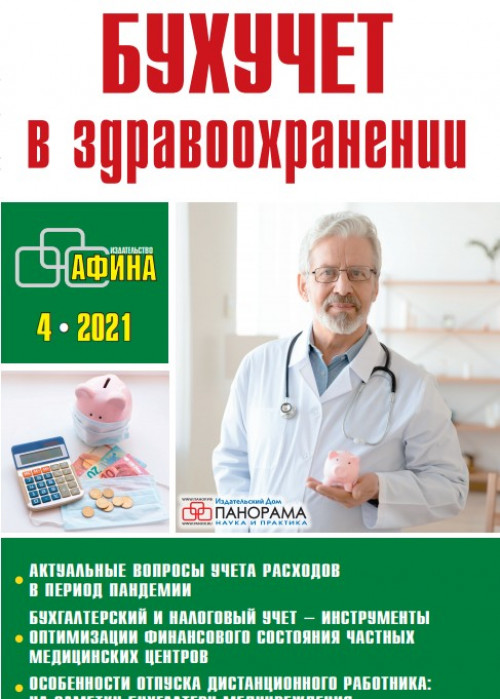
The article is devoted to the problem of accounting for expenses during the period of high alert to prevent the spread of coronavirus infection in dental clinics that provide paid services. This article discusses the concept of expenses, their classification, regulations governing the accounting of expenses, as well as the procedure for reflecting them in accounting. It noted that during the pandemic, problems arose with the collection of primary documents, which, in turn, complicated the work on the formation of financial statements. Particular attention is paid to the issues of attribution of expenses for salaries of employees on non-working days announced by the President of the Russian Federation.
The article reflects the peculiarities of accounting and tax accounting in domestic private medical centers, presents an analysis of their financial situation (using the example of five medical organizations in Bryansk), proposes ways to improve the financial position of commercial medical centers using a competent organization of the accounting and tax system. Accountants of these economic entities should strive to maximize net profit, increase current assets and reduce short-term liabilities, since the main financial problems of private medical centers are often the insufficient level of financial stability and solvency.
The new Federal Accounting Standard (FAS) 6/2020 “Property, Plant and Equipment”, which will come into force in 2022, requires non-public sector organizations (including healthcare organizations in this sector) to take into account the impairment of property, plant and equipment. Such accounting is qualitatively new for these organizations. Consequently, it is very important to conduct a separate research of the rules for determining and recording the impairment of property, plant and equipment of non-public sector organizations. This research is the subject of this article. As research methods, the following were used: grouping method, analysis and synthesis, comparison, analogy method, logical approach, systematic approach. As a result of the research carried out, the article focuses on the fundamental issues of accounting for the impairment of the property, plant and equipment of non-public sector organizations (including healthcare organizations in this sector), identifies the most important problematic issues in this area and presents proposals for their solution.
A single limit on the value of fixed assets for all commercial organizations, equal to forty thousand rubles and existed in accordance with the Order of the Ministry of Finance of the Russian Federation of December 24, 2010 № 186n in PBU 6/01 “Accounting for fixed assets” from January 1, 2011 in the new standard — FSBU 6/2020 “Property, plant and equipment” does not apply. Organizations themselves can determine such limits for their organizations, above which they will consider objects as fixed assets, and below which they will write off to expenses of the current period. The regulator also granted the reporting entities the right to switch to the new accounting procedure voluntarily from January 1, 2021, or, already on a mandatory basis, from January 1, 2022. The article examines, using an example, a retrospective and prospective transition to new individual limits for fixed assets from January 1, 2021.
The article is devoted to a new procedure for medical organizations to use the funds of the standardized safety stock of the Federal Compulsory Medical Insurance Fund and the territorial compulsory medical insurance fund, which is aimed at financing the organization of additional professional education of medical workers under advanced training programs, as well as the acquisition and repair of medical equipment. The main provisions of this Order, which entered into force on March 1, 2021, are considered. It is noted that starting from 2022, the maintenance of the plan and territorial plan of events for the use of these funds, as well as the reporting provided by medical organizations based on the results of such events, will be organized in electronic form using the state information system of compulsory medical insurance.
A comparative analysis of the latest changes in labor legislation concerning the implementation of the right to leave by remote workers is carried out. The article considers the legal differentiation of the norms on vacation of remote workers who perform remote work in accordance with the employment contract on a permanent basis, and remote workers who perform remote work temporarily. The complex issues of the application of labor legislation to remote relations and the applied models of vacation regulation are considered; restrictions that cannot worsen the situation of a remote worker, deprive him of constitutional guarantees, or restrict his right to rest.
The article discusses the features of the impact of professional ergonomic factors on the development of various chronic diseases of workers in the construction industry. According to the results of the study, it follows that among the occupational diseases of builders, such as diseases of the cardiovascular system under the influence of occupational noise, as well as diseases of the musculoskeletal system, will be especially distinguished. Accordingly, it is necessary to take measures to prevent the consequences and prophylaxis of such diseases in representatives of the construction professions.