Subscription request:

podpiska@panor.ru

For all questions:

+7 495 274-22-22

UDK: 616.65–089.87–06:616.62–008.22–08 DOI:10.33920/med-14-2304-08

Physiotherapy in rehabilitation of patients with urinary incontinence after radical prostatectomy

Grushina Tatiana Ivanovna Dr. Med. Sci., Leading Researcher, Department of Medical Rehabilitation, MCRP MRRSM of Moscow Healthcare Department, Zemlyanoy Val, 53, Moscow, 107120, е-mail: tgrushina@gmail.com, http://orcid.org/0000-0002-0945-4266
Musaev Ivan Elmarovich postgraduate student, Departments of Physical and rehabilitation medicine with a course of clinical psychology and pedagogy, Central state medical academy of department of presidential affairs, 19, Timoshenko str., Moscow, 121359, е-mail: tgmi97@yandex.ru, http://orcid.org/0000-0003-2461-7905
Gusakova Elena Victorovna Dr. Med. Sci., department chairman of Physical and rehabilitation medicine with a course of clinical psychology and pedagogy, Central state medical academy of department of presidential affairs (19, Timoshenko str., Moscow, 121359), head of the rehabilitation service, Hadassah Medical (Moscow, 46, Bolshoy bulvar, 121205), е-mail: gusakova07@mail.ru, https://orcid.org/0000-0002-9711-6178

The leading treatment for prostate cancer is radical prostatectomy with variations of access to the affected organ which leads to urinary incontinence in the postoperative period. In order to treat this complication, conservative methods, including a wide range of physical factors, are used. The purpose of the article is to conduct an analytical review of the literature on physical methods of treating urinary incontinence in patients with prostate cancer after radical prostatectomy. Materials. The review included data from the following electronic databases: Scopus, Web of Science, MedLine, Wiley, World Health Organization, the Cochrane Central Register of Controlled Trials, ScienceDirect, PubMed, eLibrary, CyberLeninka, and disserCat. Results. The research databases include various methods of exercises for the pelvic floor muscles with or without using the method of electromyographic biofeedback, Pilates, general, local, and penile vibratory therapy, transanal, pudendal, and tibial electrical stimulation, electrical stimulation of the pelvic floor muscles and bladder, and extracorporeal magnetic stimulation. Conclusion. It seems impossible to determine the most effective method of rehabilitation due to the large variability of treatment protocols, sample sizes, timing of the start of procedures, techniques, and assessment time points. No study has data on the patients’ catamnesis. Further studies and the search for a drug-free non-invasive method of physical therapy for the rehabilitation of prostate cancer patients who have undergone radical prostatectomy are justified.

Введение

По данным официальной статистики, в основном объеме контингента больных со злокачественными новообразованиями населения России рак предстательной железы в 2021 г. составил 7 % [1]. Основой его противоопухолевого лечения является радикальная простатэктомия (РПЭ) с различными вариантами доступа к пораженному органу. Несмотря на то что ее осложнения очень разнообразны, наиболее часто отмечаются недержание мочи и эректильная дисфункция [2, 3].

Недержание мочи после РПЭ значительно варьирует: от 1 до 87% [4]. В течение года недержание мочи, которое чаще всего связано с повреждением сфинктера уретры, встречается почти у 25% больных [5].

Для лечения урологических осложнений после РПЭ используются хирургические и/или консервативные методы [6–8]. К последним относится и достаточно широкий спектр физических факторов, обладающих противовоспалительным, вазокорригирующим, спазмолитическим, анальгетическим и многими другими эффектами [9–11].

Цель — провести аналитический обзор имеющихся литературных данных по физическим методам лечения недержания мочи у больных раком предстательной железы после радикальной простатэктомии.

Материалы

Обзор включал данные из электронных баз Scopus, Web of Science, MedLine, Wiley, World Health Organization, The Cochrane Central Register of Controlled Trials, ScienceDirect, PubMed, elibrary, CyberLeninka, disserCat.

Результаты

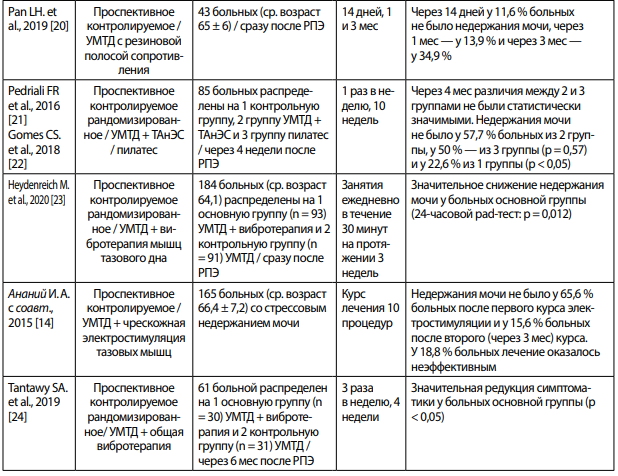
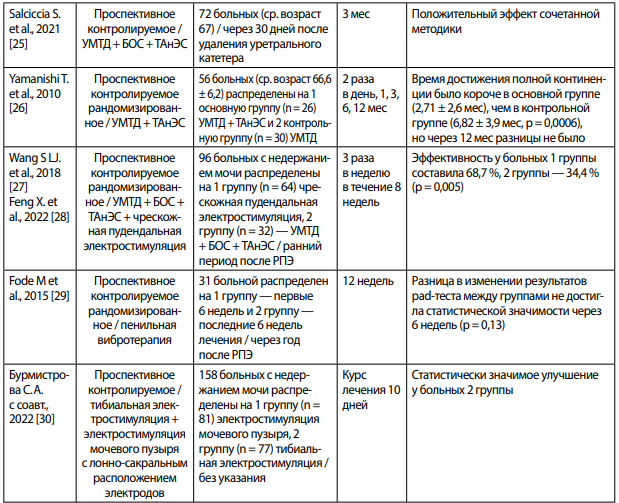
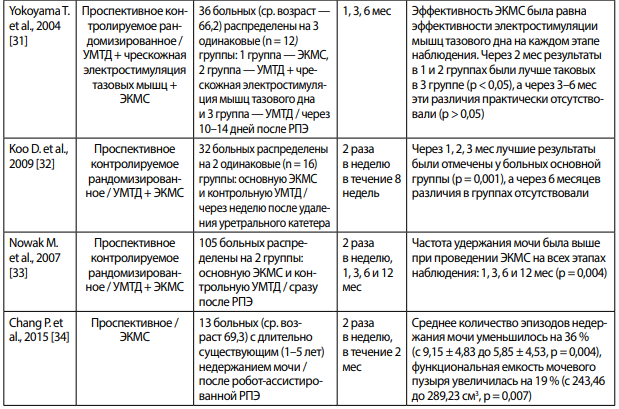
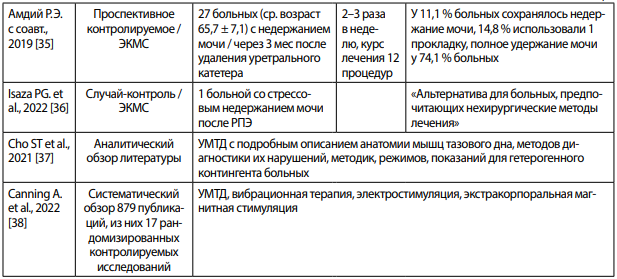
Результаты проведенного анализа представлены в таблице. При описании результатов лечения в подавляющем большинстве случаев авторы использовали количественную оценку непроизвольной потери мочи в течение 24 часов — 24h Pad-test (количество урологических прокладок, использованных за сутки).
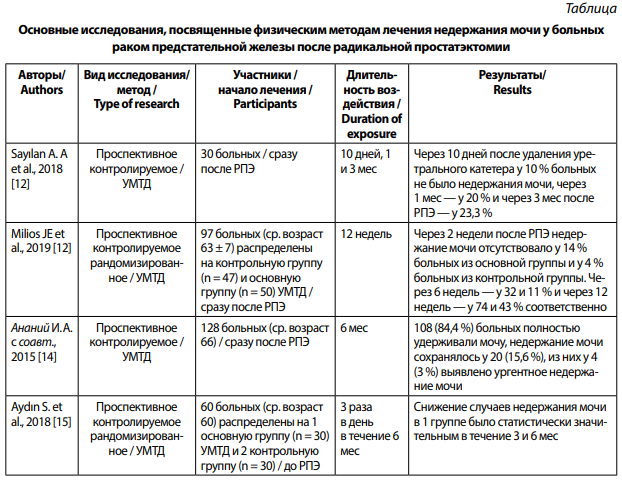
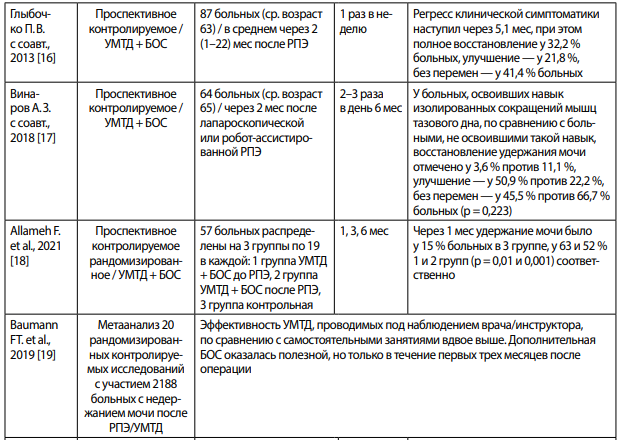
Примечание: УМТД — упражнения для мышц тазового дна, ТАнЭС — трансанальная электростимуляция, ЭКМС — экстракорпоральная магнитная стимуляция.

Конфликт интересов

Авторы заявляют об отсутствии конфликтов интересов.

Источник финансирования

Авторы заявляют об отсутствии внешнего финансирования при проведении исследования.

Вклад авторов

Грушина Т.И. — концепция и дизайн исследования, редактирование статьи.

Мусаев И.Э. — сбор и предварительная обработка материалов, составление черновика рукописи.

Гусакова Е.В. — научная консультация.

Conflict of interest

The authors declare no conflict of interest.

Funding source

The authors received no specific funding for this work.

Author contributions

Grushina T.I. The concept and design of the study. Editing of the article.

Musaev I.E. Collection and pre-processing of materials. Drafting of the manuscript.

Gusakova E.V. Scientific advice

Article language:
Actions with selected: